



After 10 years of systematic breeding work, a major European partnership has succeeded in breeding one of the world's rarest tiger species.
We have been trying to find the ideal pair in Sóstó Zoo since 2015. Females have come from several European gardens, there have been miscarriages and stillbirths, but now Sabah (4), who has been living in our park since 2023, has given birth to healthy twins.
The reproduction is special because it is not only one of the rarest tiger subspecies in the world, but also one of the rarest animals in the world: while the giant panda, for example, has a wild population of 2,000-3,000 individuals, there are only 400-500 of this species of tiger subspecies in the world.
The Sumatran tiger (Panthera tigris sumatrae) is the smallest and most southerly of the 6 subspecies living today.
In the wild, they are found only in the low-lying areas and mountain forests of the Indonesian island of Sumatra. They hunt solitarily, preying mainly on medium-sized herbivores.
They have become critically endangered due to habitat destruction and poaching.
While in the 1970s the number of animals living in the wild was estimated at around 1000, today there are only 400-500 animals living in the wild, while in zoos around the world 280 animals live in the wild, including 4 here in our Zoo.
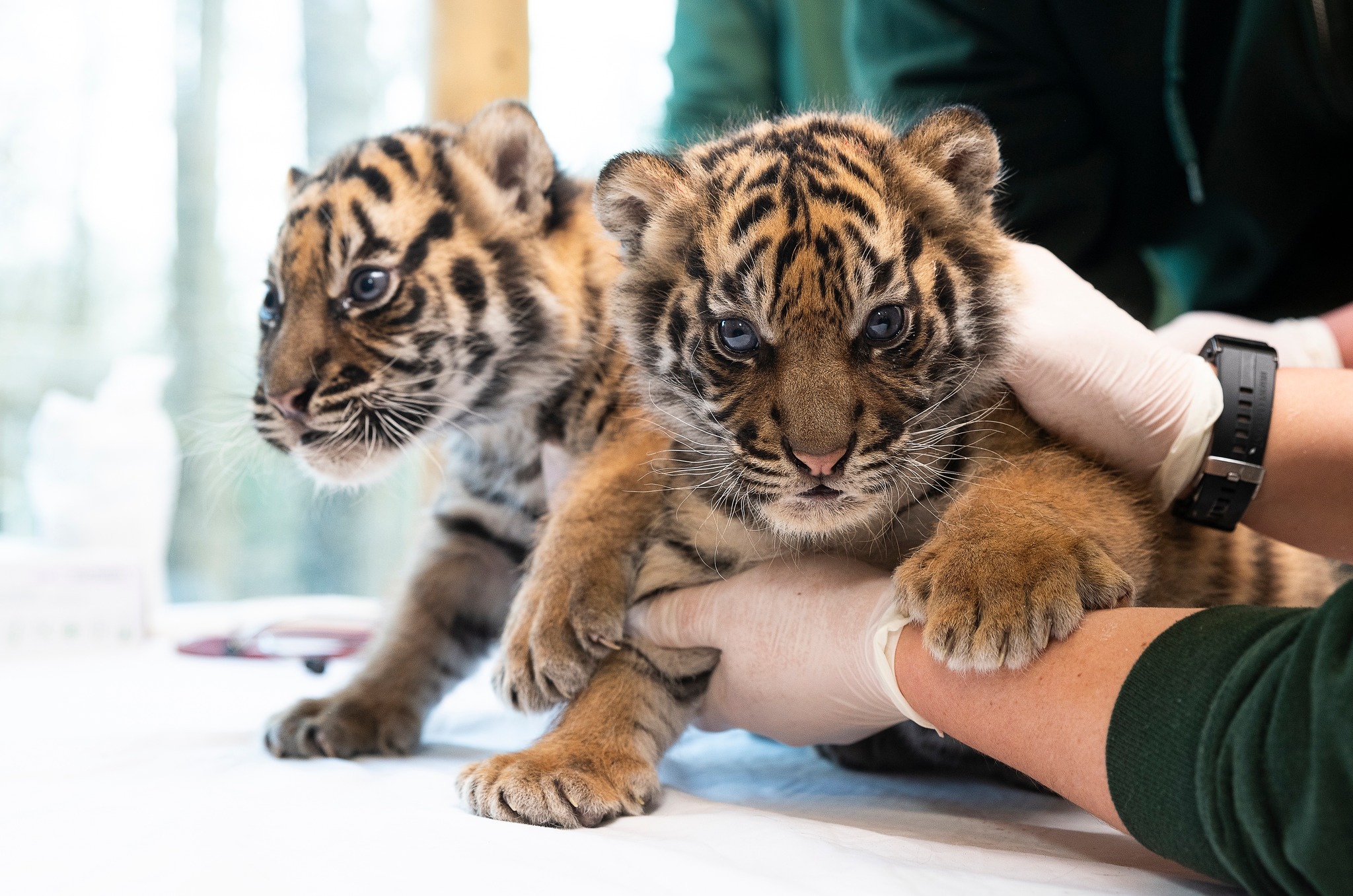
Today, the rare cubs underwent their first ever veterinary check-up at the age of 4 weeks.
In addition to a general health check, the veterinary team also provided the animals with a unique identification, a body weight measurement (5kg and 4.6 kg) and a watering test. The males were also given their first vaccine and wormers.
From this weekend, the babies can be seen in the Sosto Zoo's endangered animals exhibit in the Viktória House.